


SPACE October 2026 (No. 707)
On Sep. 4, an emergency forum on the protecting Yongsan Park was held at Heyground BRICKS Seongsu. The forum, organised by three different agencies, Seoul Green Trust, Forest for Life, and the Seoul Federation for Environmental Movement, was designed to discuss the government’s announcement in mid-August to provide affordable housing for the younger generations and newlyweds through developing Yongsan Park. By way of opening, Zoh Kyungjin (Chairman, Seoul Green Trust) emphasised the nature of the forum as one intended neither to advocate a particular political position nor to criticise any specific political party, but rather to focus discussion on the value of Yongsan Park.
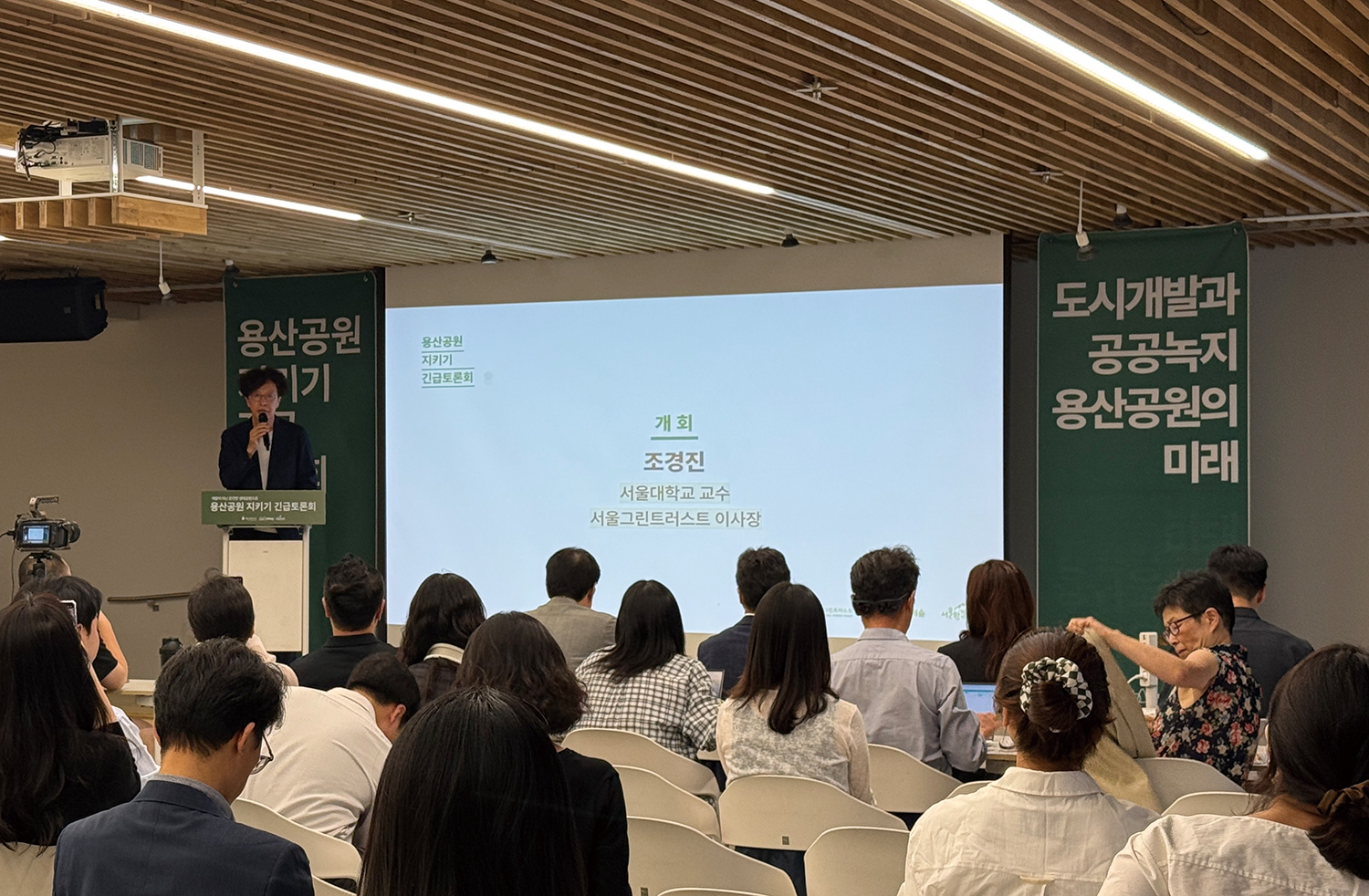
View of the Emergency Forum on the Protecting Yongsan Park ©Seoul Green Trust
Before the discussion, two presentations were given: ‘Five Reasons Why Apartments Should Not Be Built in Yongsan Park’ by Pae Jeong-Hann (Professor, Seoul National University) and ‘Conditions for an Intact Ecological Peace Park’ by Choi Young (Manager of Ecological City Team, Seoul Korean Federation for Environmental Movement). Pae opposed the housing construction on Yongsan Park by stressing the fact that the Yongsan site is ‘historic land’, ‘ecological infrastructure in the age of the Anthropocene and climate crisis’, and ‘a national project established through social consensus’. Moreover, by citing ‘feasibility’ and ‘efficiency’, he also expressed his concerns. Choi Young, meanwhile, focused on ecology and recovery. He described Yongsan Park as the only opportunity to create an ecological peace park in the heart of 21st-century Seoul, as well as a place for healing the history of foreign military presence and the tragedies that occurred over its course. Ultimately, he emphasised the need to reframe the current debate away from a political power struggle and towards a more fundamental question: how should we protect the remaining common land in Seoul?
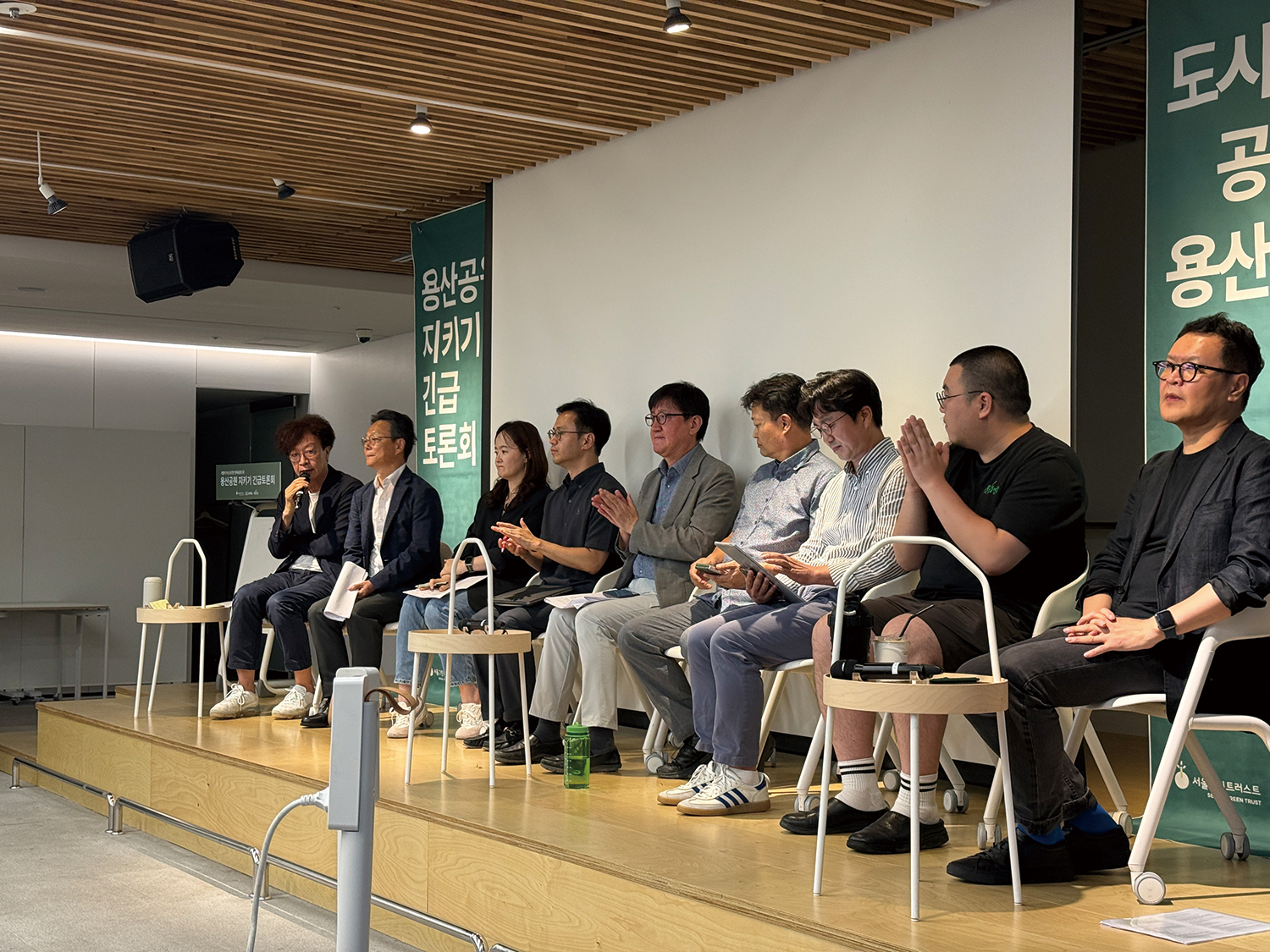
At the forum, from left to right, Zoh Kyungjin, Kim Jonghun, Kim JungBin, Lim Justin Heejoon, Seol Tongkeun, Yoo Young Min, Choi Jinwoo, Choi Young, and Pae Jeong-Hann ©Seoul Green Trust
The following discussion was moderated by Zoh Kyungjin and conducted by six experts, who offered a range of perspectives on the future use of the Yongsan site. Based on the housing proposal announced by government, Lim Justin Heejoon (Professor, Seoul National University) three-dimensionally visualised the hypothetical image of the site to examine the expected landscape, the shadows that would be cast by large-scale buildings, and potential changes to the microclimate. Kim Jonghun (Professor, Pai Chai University) proposed a hybrid model in which experimental and low-density housing could co-exist with park life by respecting and adapting the existing heritage. Kim JungBin (Professor, University of Seoul) emphasised the contribution of green space to urban competitiveness and demanded to establish an independent governance for a large-scale project, and a carefully tailored framework for funding. Yoo Young Min (activist, Forest for Life) argued that constructing housing on the Yongsan site alone would not resolve any housing issues. Choi Jinwoo (specialist, Seoul Korean Federation for Environmental Movement) asserted that environmental rights and housing rights should not be treated as an either-or choice, but as public goods that must both be secured in their respective domains. Finally, Seol Tongkeun (Chairman, Korea Forest Ecology Leader Association) emphasised that the intentions behind the Special Act on the Creation of Yongsan Park, established through social consensus, should not be undermined.
The government added that the proposal would undergo a process of public consultation to assess public opinion. Yet the transformation of the Yongsan site into a park has already been the subject of decades of discussion. It dates back to Roh Taewoo’s 1987 presidential campaign pledge to the enactment of the Special Act on the Creation of Yongsan Park in 2007, the international design competition for Yongsan Park in 2011–2012, and, more recently, the completion of a preliminary design and plan that further developed the winning proposal. Without sufficient understanding of the background or respect for the accumulated social consultation, research, and planning, simply introducing a new housing proposal is close to wasting social resources. The organisers stated that they would continue to provide such forums for public discussion from the perspective of civil society in order to sustain debate over the future use of the Yongsan site. A second forum, bringing together experts from other fields, is scheduled to take place at the same venue on Oct. 2.
