


SPACE October 2026 (No. 707)
On Sep. 1, Memories for the Future: 25 Years of Hermès Foundation Missulsang, a digital archive documenting the 25-year history of the award from its inaugural edition in 2000 through to its 20th edition, was released to the public. The 451-page digital publication includes a foreword by Olivier Fournier (President, Fondation d’entreprise Hermès), an Editor’s Note by Ahn Soyeon (Artistic Director, Atelier Hermès), critical essays by Kim Honghee (Chairperson, Nam June Paik Cultural Foundation) and Yoon Wonhwa (Art Critic), and interviews with Menehould de Bazelaire (Director of Cultural Heritage, Hermès International) and the former Artistic Directors of Atelier Hermès (Kim Sung Won, Park Manu, Beck Jee-sook, Kim Yunkyoung). The archive also features all 20 editions of the award, listed chronologically, with artist’s essays excerpted from the original catalogues and exhibition photographs. Of 20 catalogues, seventeen back issues have also been made accessible through links embedded in the archive.
Back in 2000, when Hermès first launched the programme, ‘Hermès Korea Missulsang’ for Korean artists, there was no Korean collection nor an Hermès exhibition space in Korea. Therefore, the first three editions were held at Gallery Hyundai. However, the award entered a new phase in 2003, when it was co-organised with Art Sonje Center. Previously, a single winner was chosen through nomination and jury review, followed by an exhibition and award ceremony. Under the new joint organisation, the nominating committee first drew up a shortlist from which the jury selected three artists. All three finalists were then supported in producing new work and presented their works in an exhibition before the final winner was selected. Later in 2005, when Art Sonje Center temporarily closed, the award exhibition moved to the newly opened Atelier Hermès. With the establishment of the Hermès Foundation in 2008, the award authority was transferred from Hermès Korea to the foundation, and its name was subsequently changed to the ‘Hermès Foundation Missulsang’. Even under new management, the award retained its original Korean name ‘Missulsang’, instead of translating it into its English translation ‘Art Prize’. Kim Sung Won explained this choice as a way of respecting the specific context of Korean contemporary art.
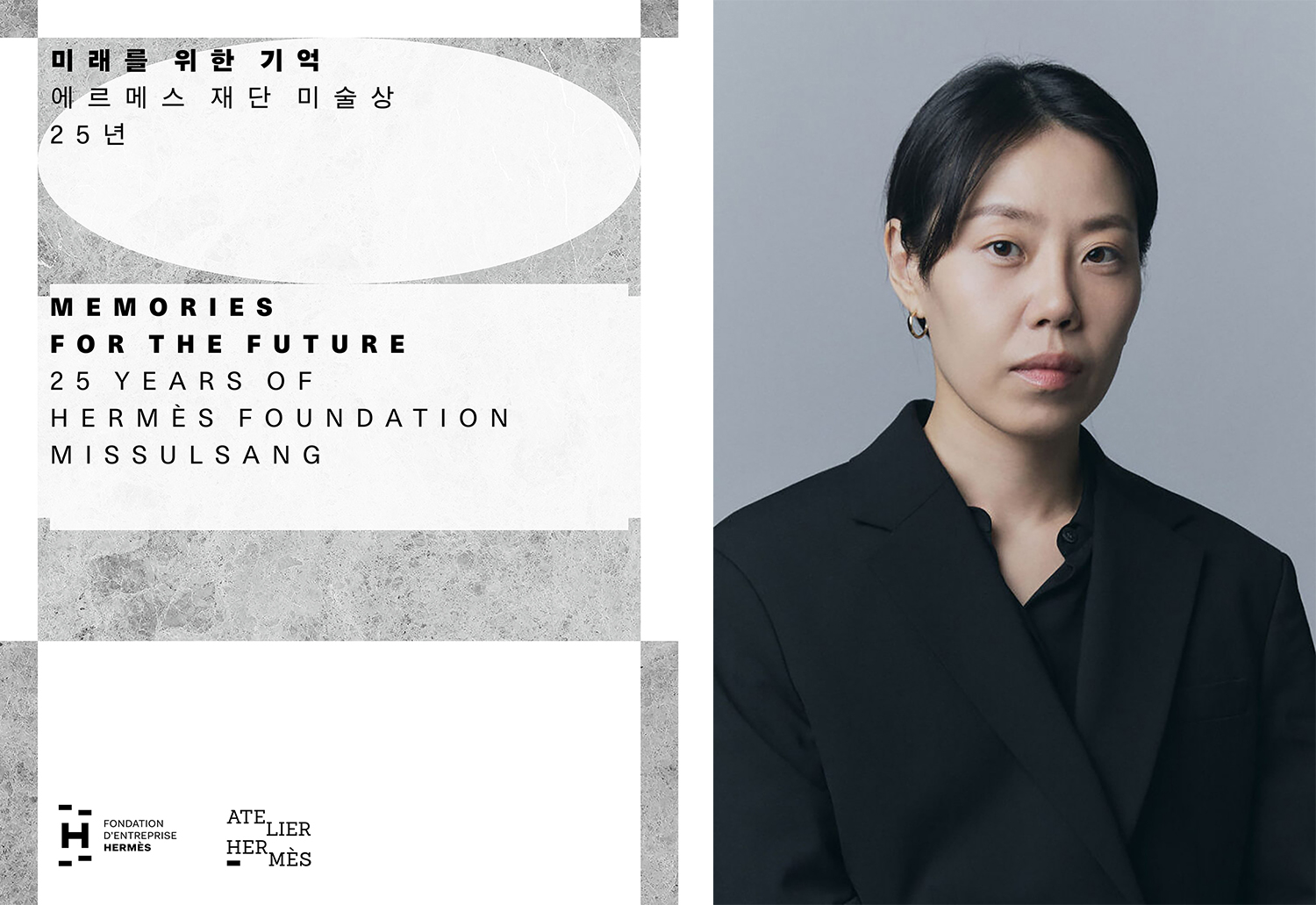
(왼쪽) 에르메스 재단 미술상 디지털 아카이브 「미래를 위한 기억: 에르메스 재단 미술상 25년」 Image courtesy of Fondation d‘entreprise Hermés (오른쪽)에르메스 재단 미술상 제21회 수상자 차재민 Image courtesy of Fondation d‘entreprise Hermés / ©Lee Seunghee
Beginning with its 16th edition in 2016, the award was restructured once again to select a single recipient every two years and present a solo exhibition of their work. In the interview with former artistic directors, Beck Jee-sook recalls that, as the award entered its second decade, numerous discussions emerged around its future direction. Shifting to a biennial format and providing more concentrated support to a single artist was one of the proposals that emerged from these discussions. In March of this year, Cha Jeamin was selected as the recipient of the 21st edition. Her solo exhibition, scheduled for May 2027, will be the first exhibition to be held at Atelier Hermès, located on the basement level of Hermès Maison Dosan, following the completion of its renovation.
Over these 25 years, not only has the structure of the award continued to evolve, but the practices of its winners and finalists have also developed in parallel with broader shifts in Korean contemporary art. In her essay included as part of the archive, Kim Honghee categorises the award’s 25-year history into three phases, tracing key trajectories in Korean contemporary art: from the textuality of Young-Hae Chang Heavy Industries, the mobility of Do Ho Suh through the socially critical practices of Kim Sung Hwan, Yangachi, and Kim Sangdon; to works at the intersection of the body, technology, and virtuality, represented by Jeong Geumhyung, Ryu Sungsil, and Kim Heecheon.
In particular, she argues that in the early 2000s, the award served as an institutional platform to recognise the sensibilities of a new generation of Korean artists while giving their practices greater international exposure. In the Editor’s Note, Ahn Soyeon reflects on the process of archiving and compiling 25 years of records: bringing together previously published individual catalogues and supplementing lower-resolution archival materials with installation images to show how the works were presented at the time. The digital archive is currently available to the public in both Korean and English through the Atelier Hermès section of Hermès Korea’s official website. A French version will be made available at a later date on the official website of the Hermès Foundation.

0