SPACE October 2025 (No. 695)
The second iteration of ‘The Revival of Korean Architecture Criticism’, organised by Seoul Architecture Forum, was held on the 28th of August at the office building of Junglim Architecture. The two critics, Lee Dammy and Park Junghyun, used archiromaky and apparat-c as the subject matter for critique. While this event did not lead to conclusive answers to questions such as ‘How one should define criticism?’ and ‘In so far as there is an architectural criticism, how can one speak of its restoration?’, however, it identified new and currently possible critical approaches as well as outlining their limitations.
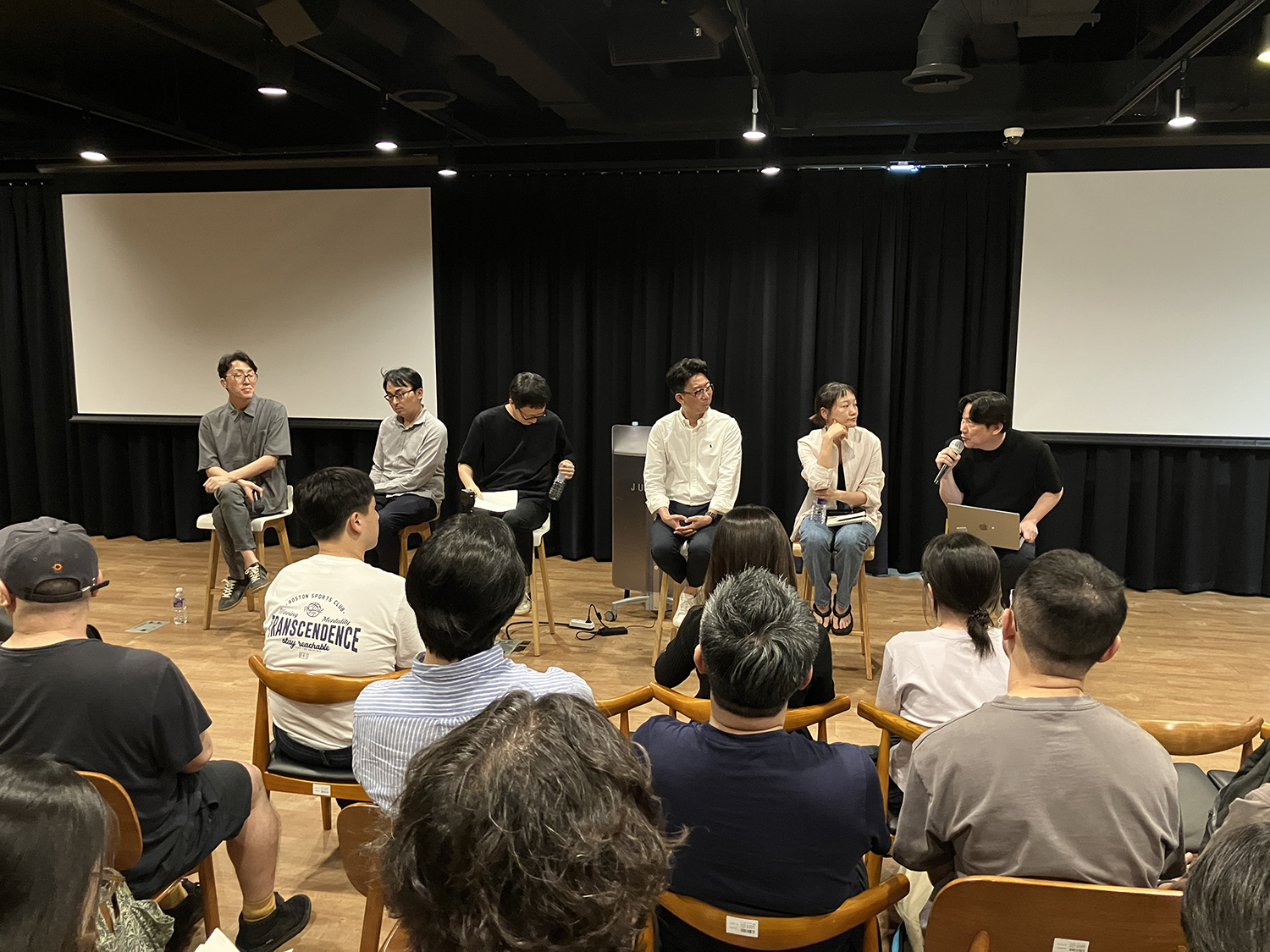
From left to right: Lee Sewoong, Choi Yeonyung, Park Junghyun, Yim Jinsoo, Lee Dammy, Hyun Myungseok. ©Lee Sowoon
‘Contaminating’ by ‘Metamorphosis’
With the title ‘The Problem of Metamorphosis’, Lee Dammy (principal, Flora and Fauna) – assuming diverse roles such as architect, client, and non-human – chose to ‘contaminate’ the single-track narrative that heroises architects by admitting a more chaotic imaginative space, coincidence, and fiction.
The word ‘metamorphosis’ is most immediately reminiscent of Franz Kafka’s Metamorphosis(1915) presenting the insect as beneath the human. However, in the post-Kafka literary world, insects are no longer dismissed but celebrated or treated as no different from humans. Instead of using it as a device to metaphorically represent human beings as non-humans, metamorphosis is now welcomed as a ‘volitional change into another being’. To loosely connect this with Lee’s idea of ‘a will to learn new things through not knowing’, Lee as architect willfully decides to transform into beings that she does not know: ‘the client, the co-workers, the collaborators, the passers-by, and the building that witnesses everything’. To add something special about Lee aside from her status as an architect [if we could boldly infer from Park Junghyun (editor-in-chief, Labyrinths)’s designation of himself as a ‘heterosexual middle-aged male’ during the discussion while remaining conscious of Lee’s active participation in criticism and familiarity with the latest trends in contemporary discourse] perhaps we could say that Lee exudes a queer and new kind of feminine attitude. Another keyword that I want to draw attention to is ‘contamination’. While Lee did not explicitly make the reference, the word ‘contamination’ is a core concept in Anna Tsing’s The Mushroom at the End of the World (2021) where it is explained that pine mushrooms ‘contaminate’ capitalism to secure diversity. As an organism that flourishes in deforested areas, burned-down forests, and forests that were destroyed by the construction of military bases and other human interventions, pine mushrooms rely not on our capitalistic system but on the forest’s ecological system to flourish. They are harvested not by systematised factory workers but by unofficial laborers such as the refugees employed in Oregon, immigrants, and non-regular workers. It is only when they get to the stage of exports and sales that these mushrooms become a part of the free market system. What is meant by ‘contamination’ then is in reference to the way these mushrooms, as an aberrant hybrid of both capitalistic commercialism and a non-capitalistic ecological system, disrupt and reveal the defects of a seemingly flawless capitalism by resisting its simplistic binary division. I apply this idea to Lee’s critical approach. The ‘contaminating’ effect of pine mushrooms is used to present the role of the architect or the critical methodology.
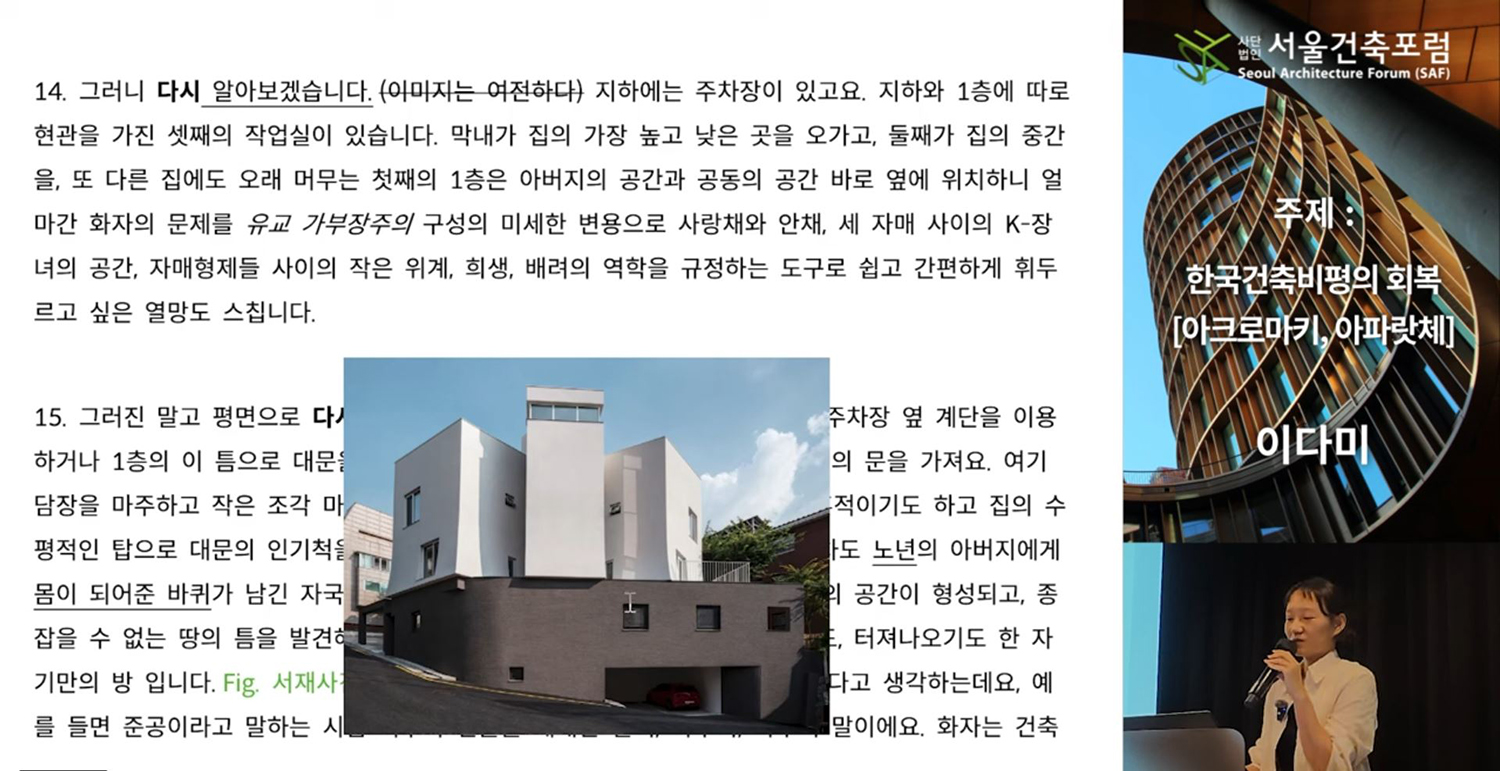
Lee Dammy explains the mass composition of La maison, je sais jamais (2022) by Acromachy. Screenshot from YouTube
First, while critiquing La maison, je sais jamais (2022) by archiromaky (principal, Yim Jinsu), Lee added her perspective as an architect, client, and narrator as a critic, and used Park Wansuh’s Identical Apartments (1974) as basis upon which to elaborate on the left-right symmetry on the second and third floors via a narrative of homogeneity and foreignness. Aside from the individual three floors of La maison, je sais jamais which are respectively occupied by the three sisters, the basement is used by the youngest as personal workspace, and the first floor where their father used to live is used — via the gap created by the topography — as a small study space. Noticing how the space is configured in such a way where the youngest occupies both the highest and lowest floors of the building and the eldest occupy the first floor that befits the position of a caretaker, Lee briefly shared how she would like to read them in relation to Confucianist patriarchy, the living space of a model Korean eldest daughter, mini-hierarchical order among the sisters, and — in regard to the study room — as a ‘room for oneself’. Moreover, the novel Identical Apartments which Lee broaches in relation to the left-right symmetrical floor plan is a story about a protagonist who – after moving into the new apartment – begins to discover how one is no different from the neighbours and finally ends up having an affair with a neighbour. Lee interpreted this conclusion as a sudden resolution to the climactic tension created by two different beings almost reaching singularity and explained how this reminded her of the innocence of a virgin. Lee then added that it is this innocence that allows one to start anew and learn new things, and that this was for her the prompt to say something novel about the simple bilateral composition of La maison, je sais jamais and its floor plan that seem both different and also similar to a terraced apartment. The floor plan might be composed of concepts (architect), but experientially speaking, the diagonally connected line of sight allows inhabitants to catch glimpses of each other (client), and this diagonal experience does not get spotted due to the windows positioned on the three and four sides and vanishes in an instant (narrator). Also, by bringing up the lack of variation in the floor plan beyond the square box as an example and noting how the apartment layout left behind something like a ‘negative’ trace, Lee pointed out how the deliberate preservation of such negative traces can be a viable approach since pursuing foreignness could risk being reduced to a capitalist logic.
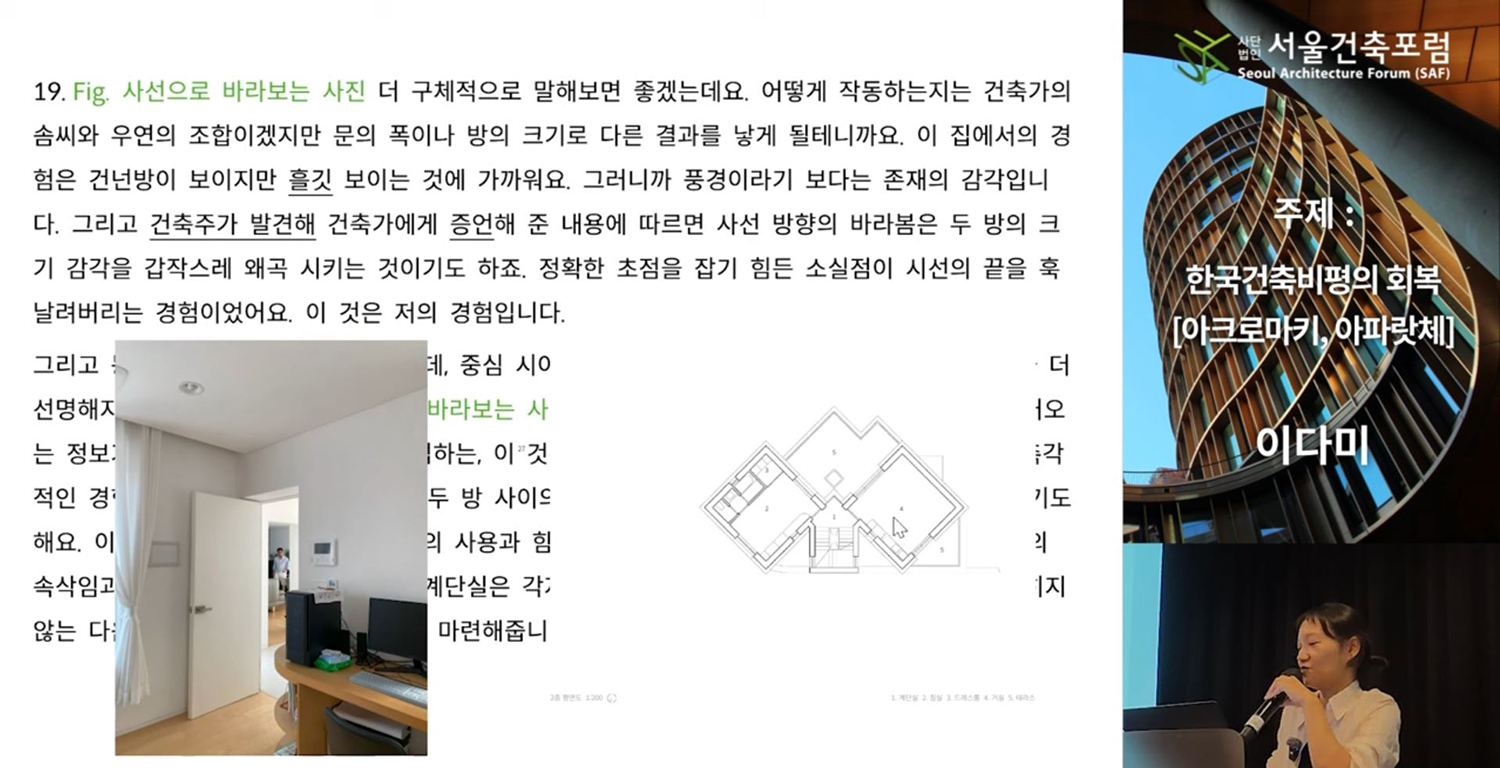
Lee Dammy explains the floor plan and interior experience of La maison, je sais jamais. Screenshot from YouTube
As for the works of apparat-c (co-principals, Lee Sewoong, Choi Yeonyung), Lee talked about cognitive problems related to butch and femme — terms connected to gender identity — and reflected on some of the studio’s projects that have been mostly discussed in terms of façade and function from the perspective of interaction between the building and the nonhuman (i.e., heat, dew, and rain). Regarding Peridot House (2017), Lee stated that while it evokes the Parthenon, it also elicits a desire to complete the broken roof of the Parthenon within the image rather than drawing attention to its façade composition. Interpreting this desire as an anticipation of fulfillment, Lee noted that this desire and anticipation resonate with the character of the roof of Peridot House. By mentioning how there is no one way to understand femme and butch considering how they can be either cognised as female, male, or both, Lee explained that there is a similar intertwinement of cognition when it comes to the roof and façade of Peridot House. She then added that while the ‘face’ is an often-used motif in apparat-c’s work, as the gaze drifts off to the side and the situation turns complex, the face undergoes change and subtly reveals various faces like the face of the rear which tends to be hidden. This delicately undermines any presupposition of the face.
Moving on to the discussion of ornamentation and the non-human, Lee reflected on architectural details like the columns which were designed to prevent thermal bridges from breaking, and how the awnings function not merely to provide shade but to emphasise the flow of rainwater. Lee also noted that it was intriguing how the flow of non-human elements like heat, dew, and rain act as a performance amidst the ornamentation, and how – being closely tied to function – such elements adorn what is crucial. Lee then summarised that while design typically centres on the tangible, there are moments where insulation or rainwater flow takes precedence in apparat-c’s projects, and it seems that they are becoming fonder of such designs.
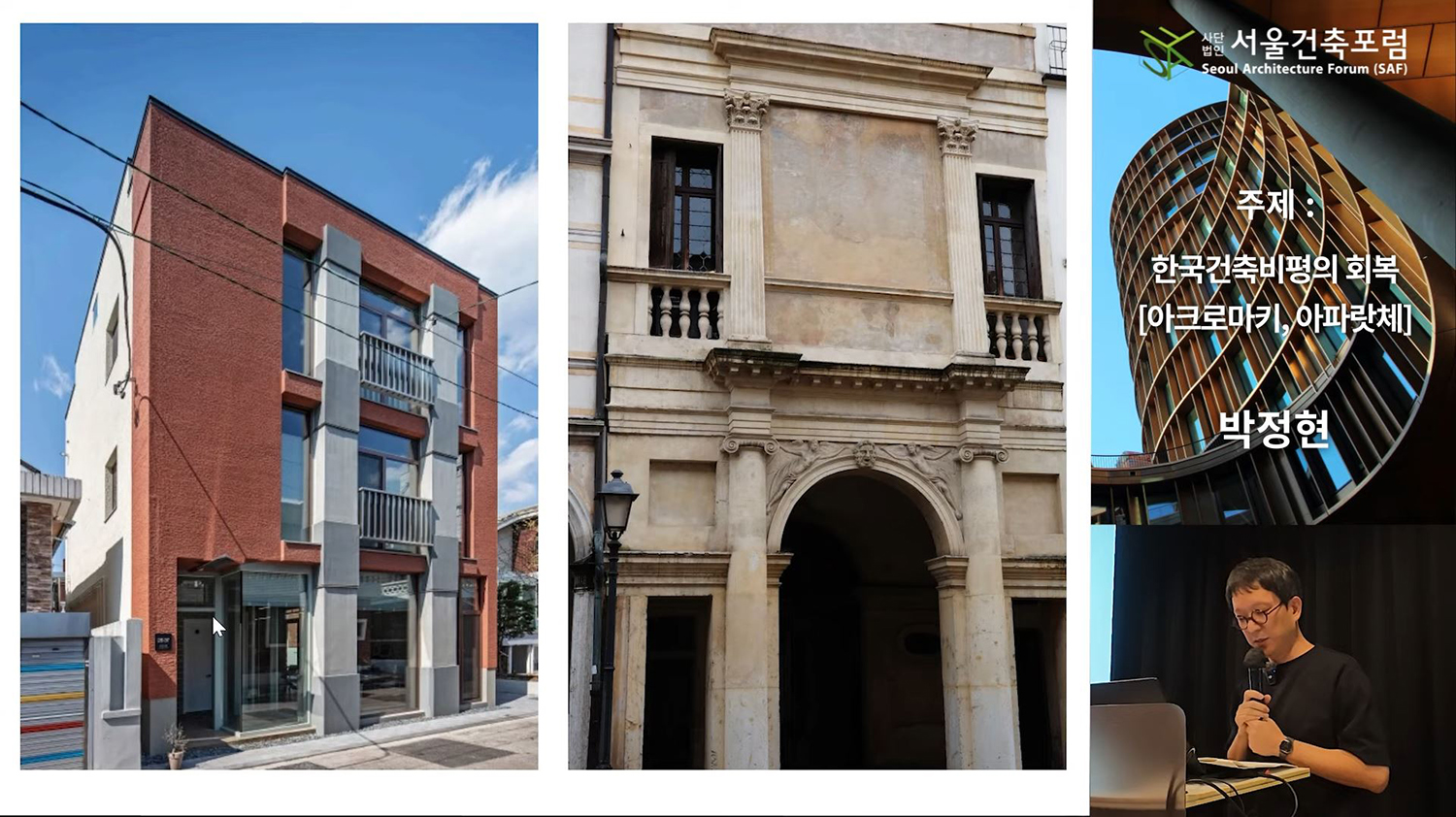
Park Junghyun explains the façade of Hongeun House (2019) by apparat-c. Screenshot from YouTube
The Common Fate of Architecture and Architecture Criticism