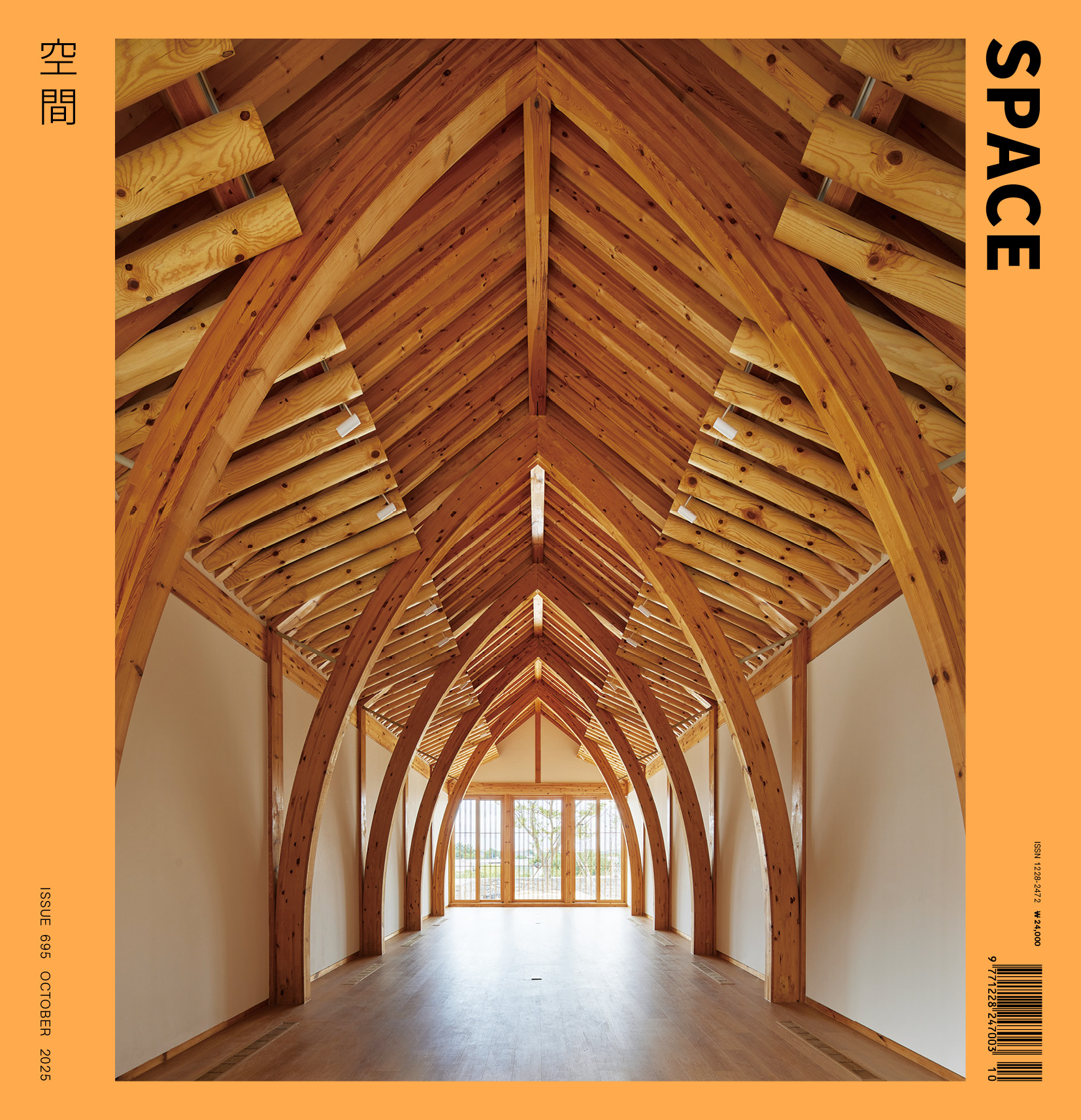
SPACE October 2025 (No. 695)
I AM AN ARCHITECT
‘I am an Architect’ was planned to meet young architects who seek their own architecture in a variety of materials and methods. What do they like, explore, and worry about? SPACE is going to discover individual characteristics of them rather than group them into a single category. The relay interview continues when the architect who participated in the conversation calls another architect in the next turn.
interview Won Gyeyeon, Lee Jeseon co-principals, studiothewon × Kim Hyerin
Loving Someone is Like Moving into a House▼1
Kim Hyerin (Kim): If I visit the studiothewon website, I’ll find a quote from Fredrik Backman’s book, A Man Called Ove. It talks about the ways that time leaves its mark on a home, and how those imperfections make us love it even more.
Lee Jeseon (Lee): While working on one of our projects, the owners of Seohyanggak (2017) recited that passage during dinner, revealing how deeply it resonated with them. The sentiment in that quotation is very similar to our own feelings about architecture and time, and the way it describes the idea of a ‘home’ closely mirrors our approach to architecture.
Won Gyeyeon (Won): When it comes to residential projects, we prioritise the various essential functions and meaningful values that aren’t immediately visible rather than focusing on impressive architectural features that please the eye. That quote is about love, but its subject is a house, and it felt similar to our attitude about designing homes. Also, since architectural firms often have an austere image that can make clients hesitate over approaching them, we thought a piece of literature on our website would help soften that impression.
Kim: You opened your firm in Gangwon-do. Tell us about that process.
Won: Since my student days, I always wanted to use my skills in my hometown. This thought lingered even when I worked in Seoul after graduation. Seoul is expensive in terms of rental costs for offices and housing, and feels crowded, so opening an office there was never an option for me. After my first project, I had no follow-up work, so I took a part-time job at another firm. That’s where I met Lee. We attended the same school but didn’t interact back then. After working together briefly, I realised I could learn a lot from her and that it would be great to work together.
Lee: My first job was at a firm that mostly handled public buildings. There, I learned about realising intentions from design to completion and how to work with various stakeholders to deliver results. But after enough training, I started feeling a thirst for a different kind of architecture. While searching for a new firm, Won suggested that we work together, and that’s how I joined. Won’s first project was a wooden house called Chalet Boomerang (2016), which deeply impressed me when I saw it. The sensibility of the wooden house was appealing, and the architect’s flexibility was evident throughout the building. I felt a strong inclination to learn about those qualities.
Kim: People often say it’s hard to work in architecture in the provinces. Do you feel that?
Lee: I think it’s a universal challenge, whether you’re in the provinces or the metropolitan area. I have not felt in any particular way that it’s harder in the provinces. Clients who want to build in Gangwon-do come looking for us, and even employees who want to experience life in Gangwon-do reach out.
Won: This may be because we are from the region, but I don’t find it especially hard to build here. The only thing is the fact that most lectures and seminars are concentrated in the Seoul metropolitan area. During Coronavirus Disease-19, I benefited from being able to attend many lectures and events online, but nowadays this doesn’t happen as often.
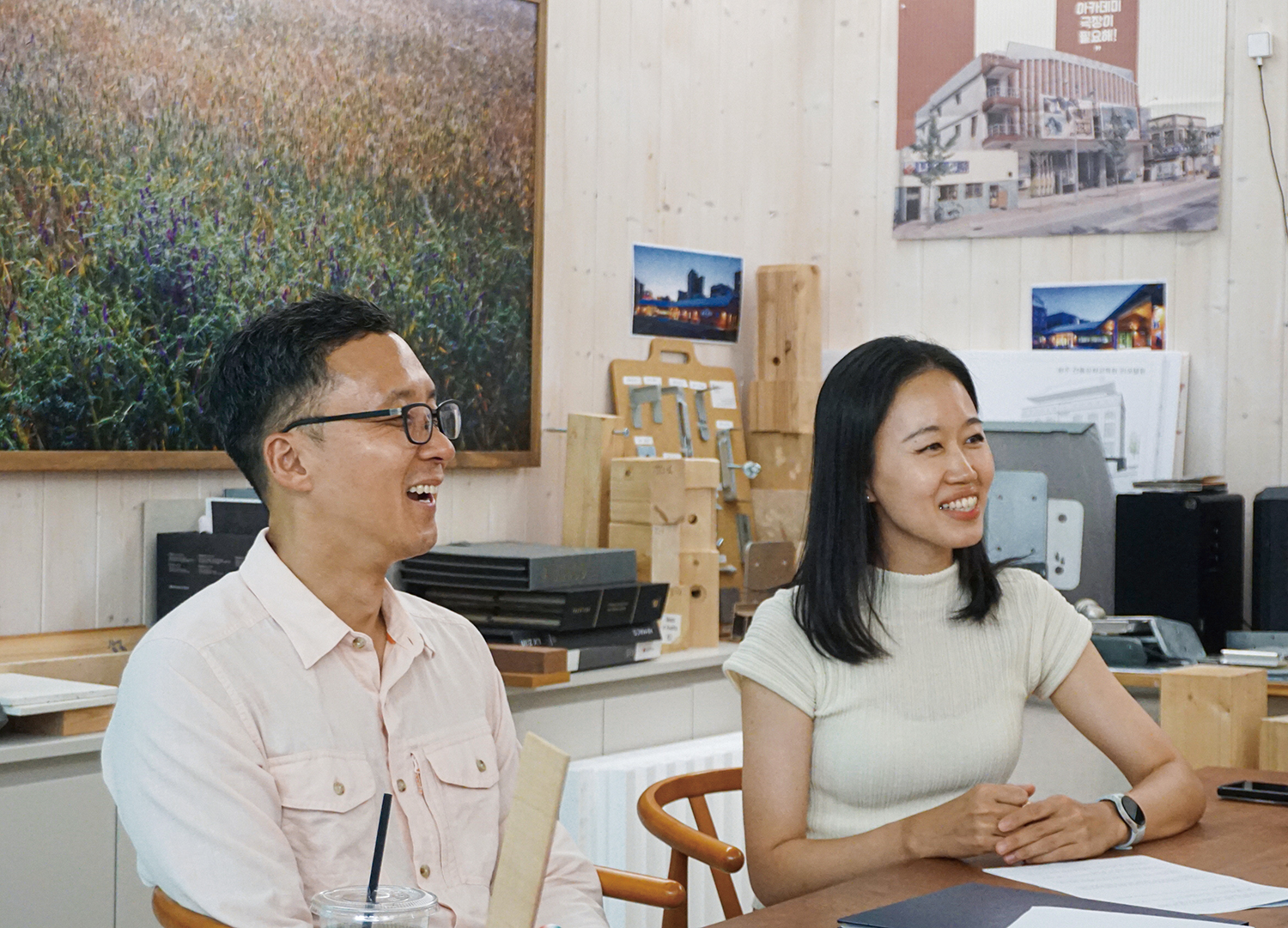
Won Gyeyeon (left) and Lee Jeseon (right)
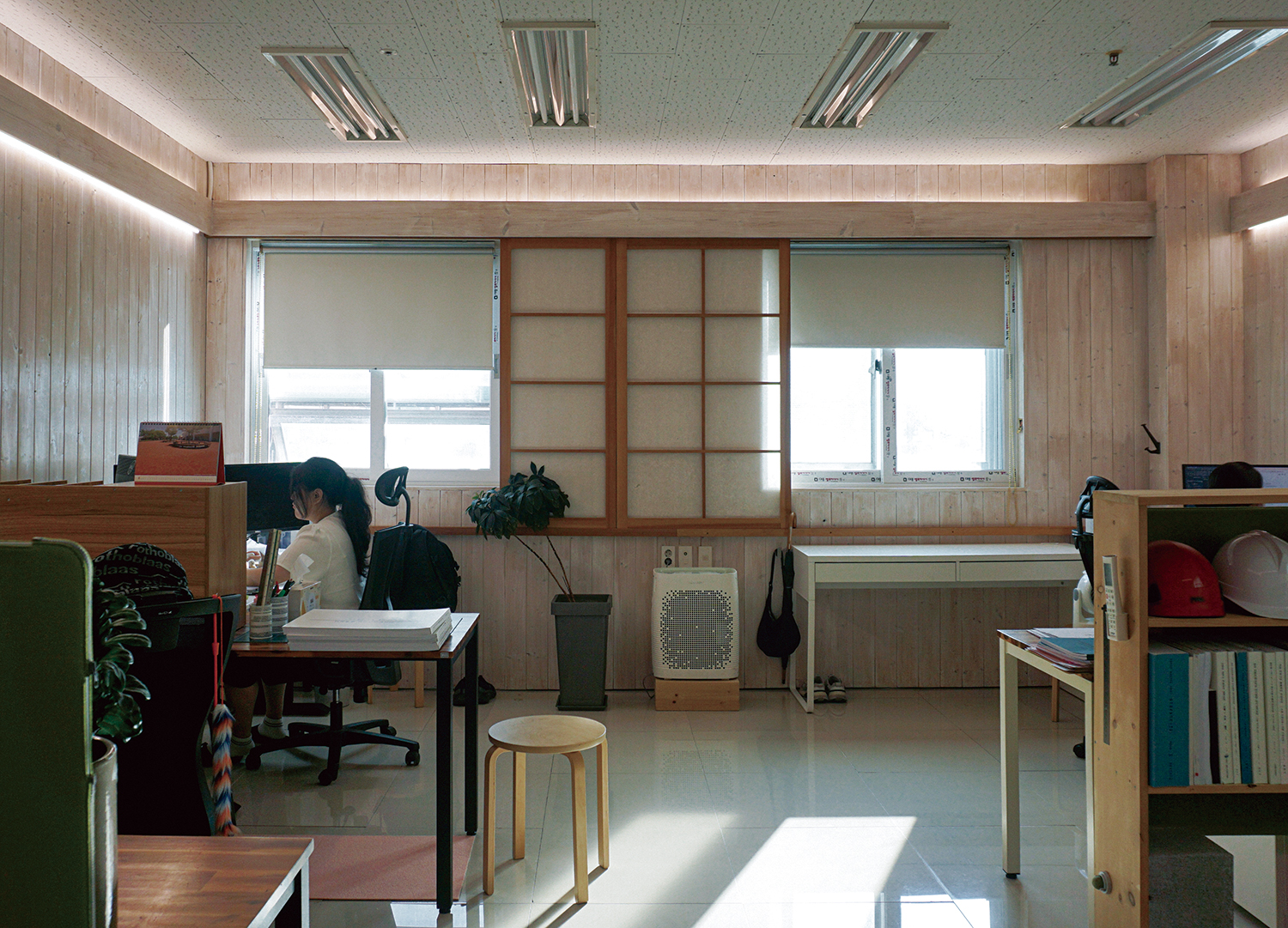
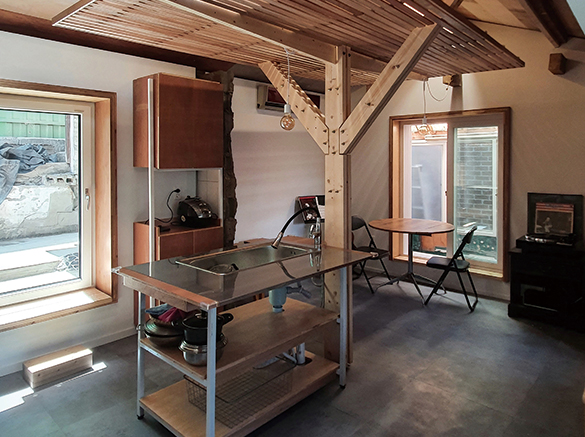
Office of studiothewon
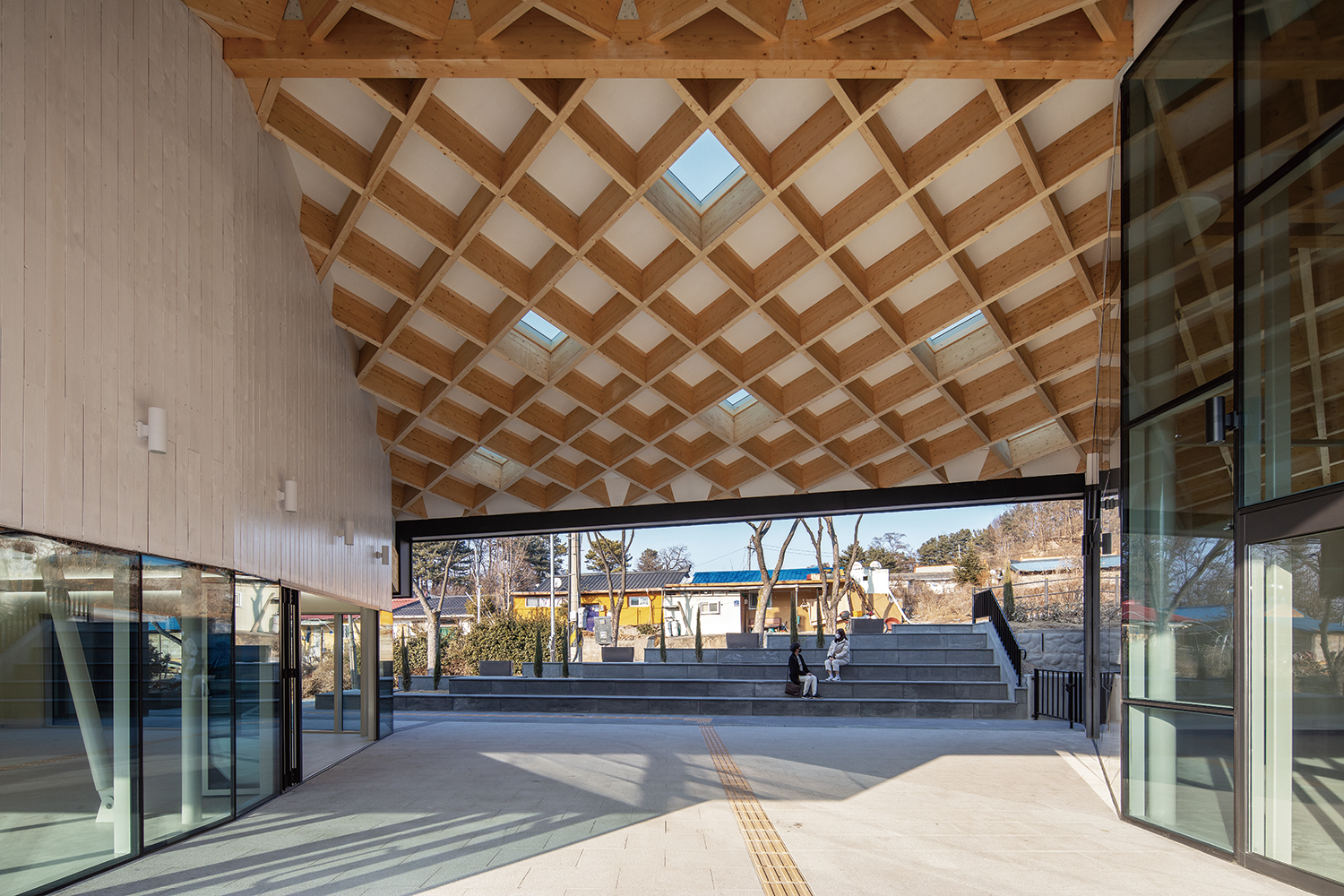
Chuncheon Farmersmarket (2022) ©Park Wansoon
Essential Structures
Kim: studiotheone is known for its diverse structural experiments. When did you first become interested in structure?
Won: I didn’t study very hard in school, but I was always interested in structure. My first project, Chalet Boomerang, involved working with timber construction. I rented a small studio apartment next to the site and lived there for seven months while constructing the building myself. During that process, I felt tremendous joy. I was able to experience how the structural beauty revealed itself as I assembled the materials piece by piece, as well as the disappointment of seeing much of that beauty disappear when it was covered up at the finishing stage. I can’t pinpoint exactly when it started, but in every project, no matter how small, we try to incorporate some structural challenge or achievement. That has become one of our design principles in the office today.
Lee: For me, getting to the essence of things is what matters most. That’s the first priority. When I think about concretising and creating space, its essence always begins with structure and therefore it was a natural instinct for me to move in this direction.
Kim: You use a mix of different structural systems—timber, reinforced concrete, light steel framing, etc.
Won: In the early days of the office, we were lucky to have several opportunities to design single-family houses, and most of the time we proposed timber structures. At that time, I thought if the joints were designed well, they could play not only a structural role but also expand into design possibilities. That’s why, starting with Gamsolchae (2019), using a heavy timber structure, we began to intentionally expose all joints. At the time, there were very few structural engineers in Korea who could properly interpret timber construction, so we couldn’t design the joints as actively as we wanted. From the next project onward, we started searching for structural engineers who could work with the kinds of systems we wanted to try out. For the Chuncheon Farmersmarket (2022), we wanted to experiment with a waffle-shaped diagrid structure. We collaborated with a structural team from the competition stage, but we couldn’t find a confident enough team in Korea, so we ended up working with a Canadian team. I was shocked when I learned that the structural engineering fee was one-third of the architectural design fee! (laugh) Still, we decided to take on the challenge, for the sake of building experience.
Lee: Being able to work with different structural materials makes it easier to realise the ideas in our heads. Even for small scale single-family houses, we might combine light steel and light timber to form a single structure, or in public buildings, we sometimes combine heavy timber and steel structures. At first, it was difficult to complete one structure using materials with such different properties, but as we kept working, the data and know-how accumulated. Now, compared to the early days, we can design with much greater freedom.
Kim: Does using multiple structures together create difficulties during construction?
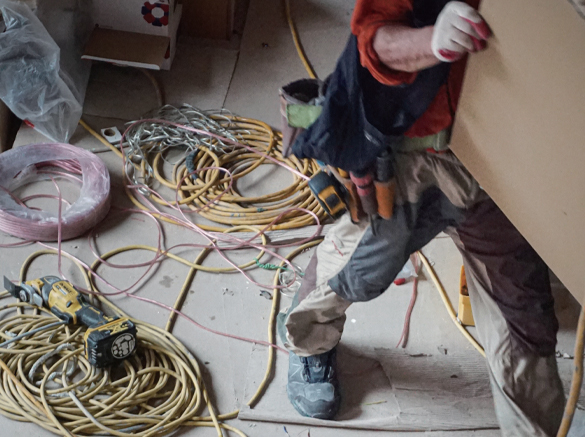
Lee: For public buildings, in order to realise the design intention, we provide as much on-site support as possible to assist contractors. For single-family houses, sometimes we even join the construction ourselves—working with carpenters, researching together, and helping directly with the details of unfamiliar joints on site.
Won: Honestly, site managers don’t find it this difficult, but they do find it bothersome. (laugh) Since multiple trades are involved, they end up having to coordinate more. Especially where steel and timber meet, they find it troublesome. But since both are dry construction methods, as long as the design is meticulously prepared, controlling the site is easier compared to wet construction. Once the parts are fabricated, it’s mostly assembly on-site. There may be some variables on site, but assuming that the design documents are complete, construction difficulty is not excessively high.
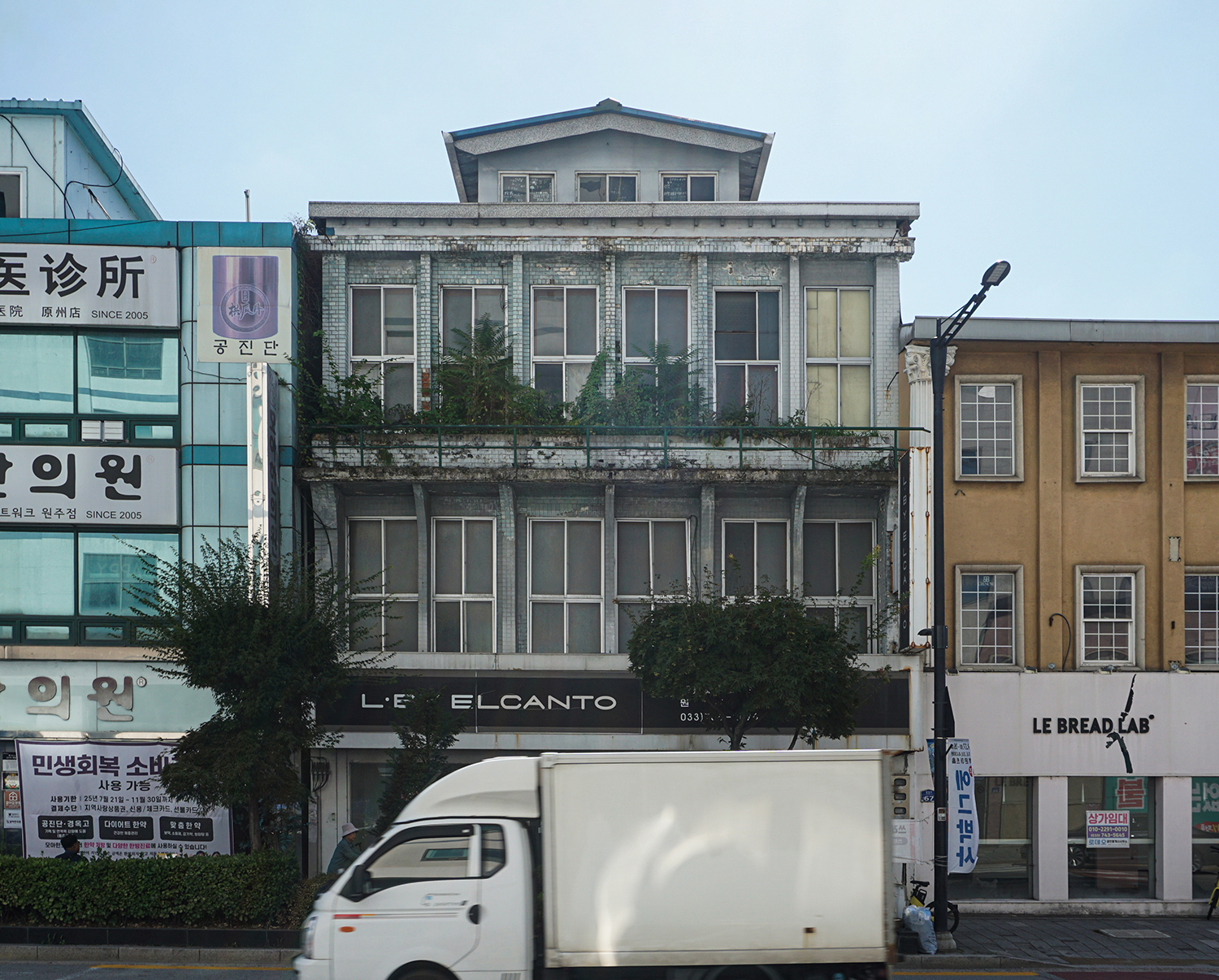
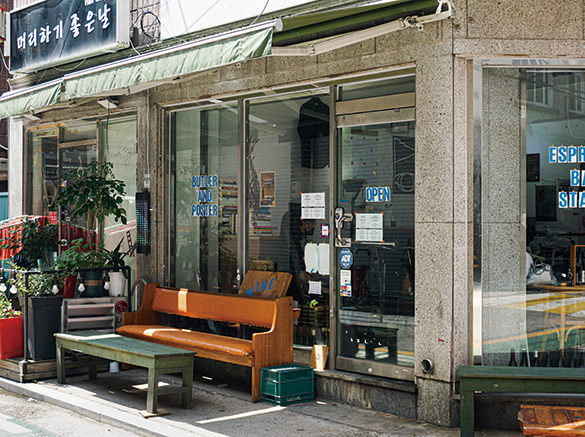
Aged buildings in the old downtown of Gangwon-do
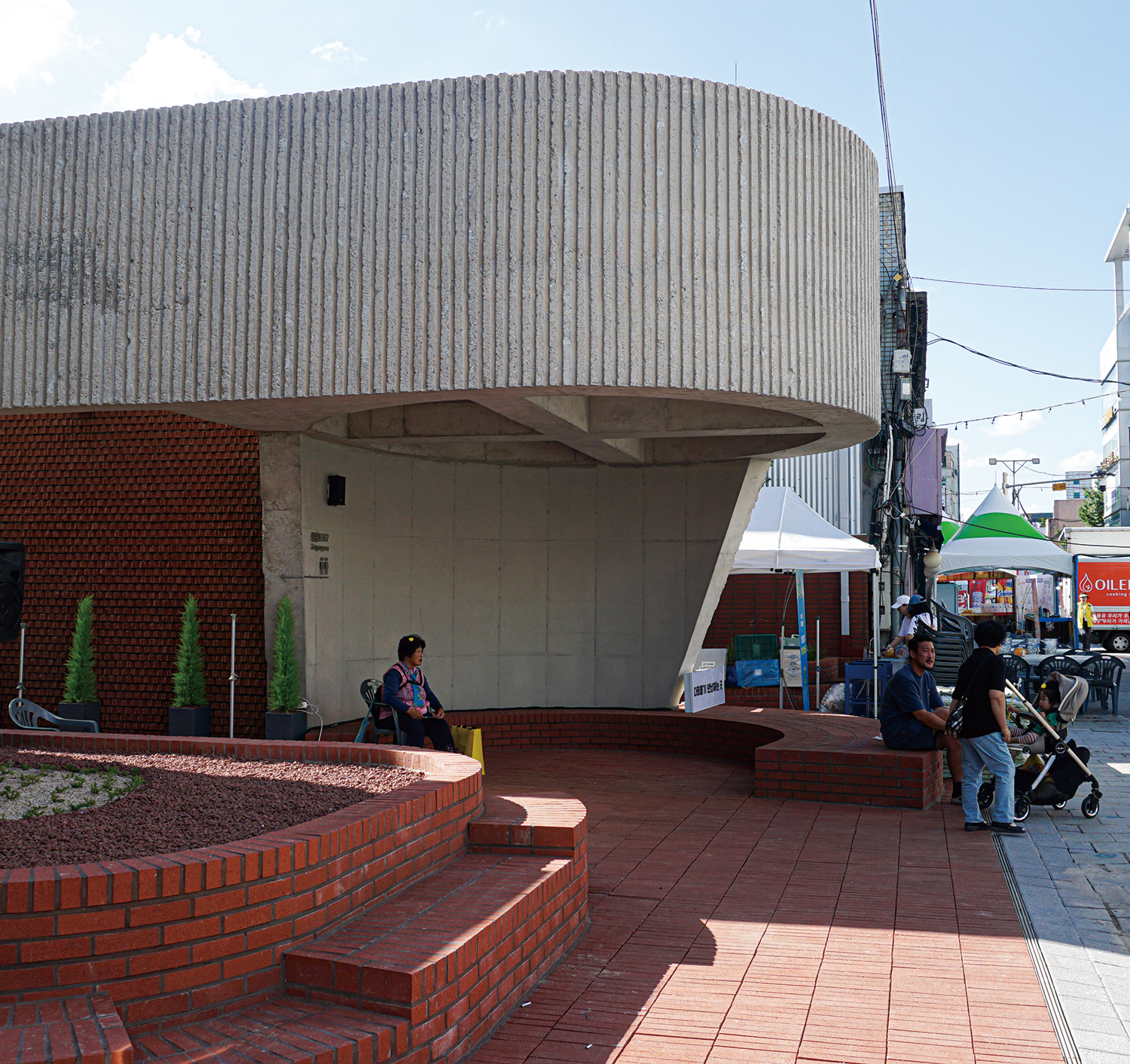
Jungang-dong Public Restroom (tentative name, 2025)
Ways of Drawing in Context
Kim: In both public buildings and houses, you often make use of semi-outdoor spaces.
Lee: I think of semi-outdoor spaces as empty yet functional. They possess many possibilities and great variety. At first, I often proposed spaces like deep eaves or daecheong (Korean traditional wooden halls) in houses, and most clients really liked them. Later, I applied this spatial concept more broadly to public buildings as well. But in public projects, inspectors who have supervised construction for decades often see semi-outdoor areas as dead space. Still, we try to convince them that such spaces are essential.
Won: These semi-outdoor spaces—daecheong, numaru, eaves—already existed in traditional Korean houses as a response to climate. But somewhere along the way, in the shift to modern architecture, they disappeared. Partly due to building systems, but also because of rapid growth and the combined logic of density and capital. Most of our projects are in low-density areas and are relatively small in scale. In such contexts, you really need a practical space to close or open your umbrella, or knock off snow and mud from your shoes. But when the apartment-style logic of maximising the floor area is applied to rural houses, we frequently see the consequences: ugly add-on canopies, or eaves as big as the house itself, which sometimes even cause legal issues. These are not optimal choices for land use or the landscape. So, we integrated those functions into our design from the start. Even in public buildings, where area and budget are less flexible, users are often satisfied.
Kim: One recent public project – the Jungang-dong Public Restroom (tentative name, 2025) – was especially striking. Even though it’s a restroom, the semi-outdoor space makes it function as a shelter and even a busking spot.
Lee: The site is in an old downtown commercial district, adjacent to a pedestrian-only street. The area has lost vitality due to urban decline and economic stagnation, but the elderly still maintain a strong street presence. So, beyond the restroom programme, we wanted to add architectural elements that the street needed—something that could inject life. We thought about applying a different form from the existing row of shopfronts, which all stand in line on the building line. Instead, we set the restroom back and created a circular semi-outdoor space facing the pedestrian street. To guide people deeper into the site, toward the restroom entrance, we designed a journey under a skylight canopy leading into the building.
Won: That street hosts a ‘chimaek’ (chicken and beer) festival, so recently we sat out front to observe carefully. We were worried people might have trouble finding the entrance, but we found that it was used very naturally. It is also working well as a busking venue. Honestly, we never thought we’d feel proud about building a restroom, but it is quite well used. (laugh)
Kim: You released your first project in 2016, and now you are looking to your 10th year. Do you plan to expand your office?
Won: Currently, there are two principals including me, plus two staff. I’d like to grow to about ten people. These days there are many design competitions. Some look very interesting, but we can’t enter them because of staffing limits. I also want to try larger-scale projects. But I don’t want a big organisation. I’d like to keep it small enough that we can maintain direct communication and dense collaboration with everyone. Since we have two principals, two teams of about five each seems right—so ideally under ten people.
Lee: As we work more, we also need fresh stimulation. We encourage everyone, regardless of seniority, to contribute ideas in the early design phase. Even if junior staff can’t fully develop their ideas, those ideas can become important sources for advancing design. Having diverse personalities in the office gives us the energy to do interesting work.
Kim: Is there a type of project that you would like to try?
Lee: Lately, we’ve been interested in landscape design. We feel landscape is as important as architecture in shaping the urban environment. If we have the chance, we’d like to try designing landscapes that are in harmony with our buildings, and we think we should start studying it more seriously.
Won: In our neighbourhood, there are many old buildings. Their top floors are usually timber structures built after the modern era. I’d love to take on one of those and really tear into it and rebuild it. Who knows when that chance will come, though. (laugh)
Kim: What direction do you see studiothewon heading in the future?
Lee: We’d like to become a firm that explores diverse design. I want to try projects that are different from what we’ve done so far. Personally, I’d like to create spaces that look quiet or object-like from the street, but reveal surprising interiors inside.
Won: Like many offices, we felt the threat of survival over the past two years. So first, I just hope we stay alive. (laugh) Looking back, there are projects we almost had but missed—projects we still regret losing. It may sound cliché, but I hope we can build an office that puts wholehearted effort into each project, so that whatever opportunities come our way, even if they don’t end up being ours, we won’t feel regret.
Won Gyeyeon and Lee Jeseon, our interviewees, want to be shared some stories from Lee Euijung (principal, Architectural Regeneration Studio) in December 2025 issue.
1 Fredrik Backman, A Man Called Ove, Forum, 2012
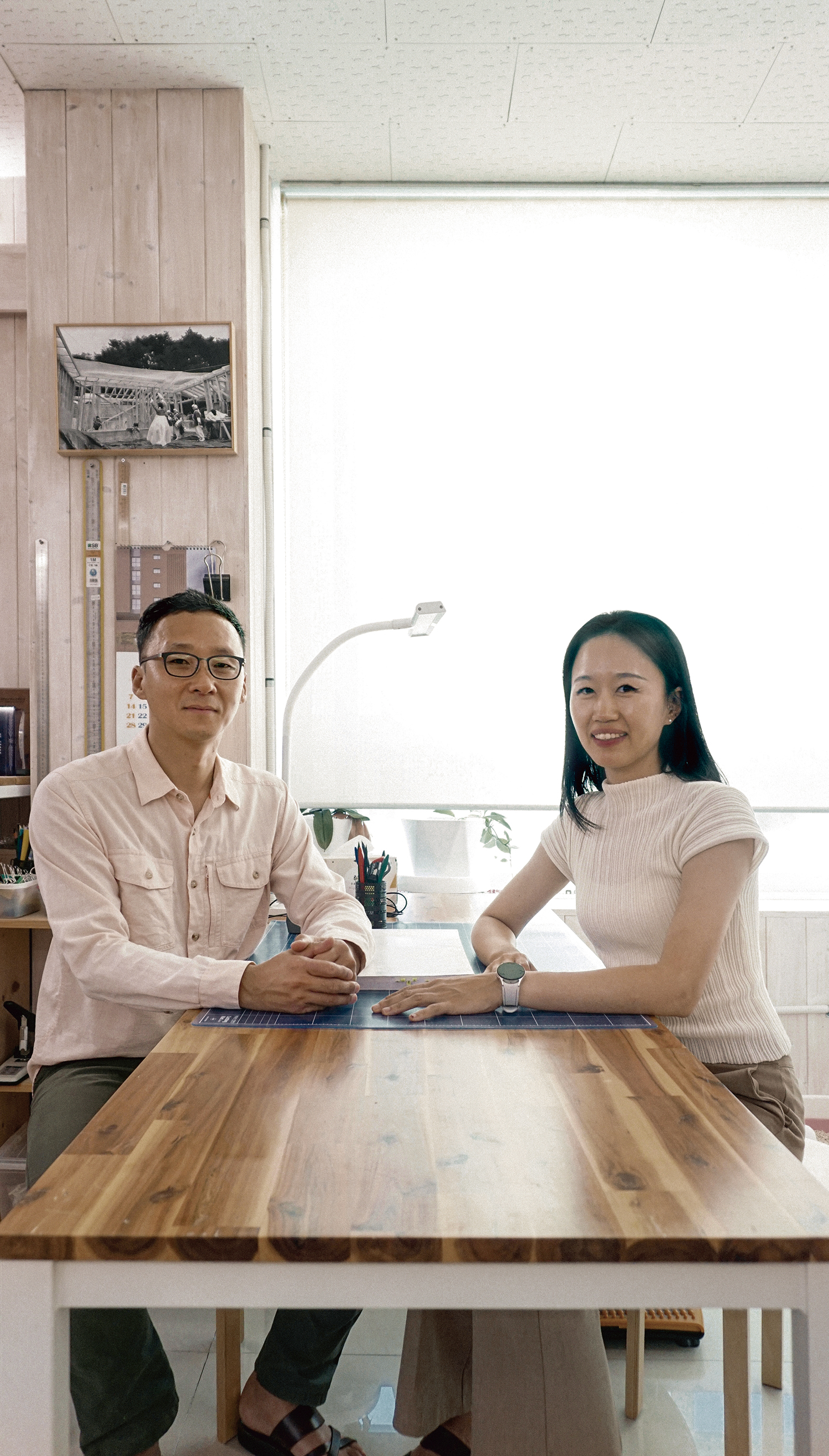
Won Gyeyeon and Lee Jeseon